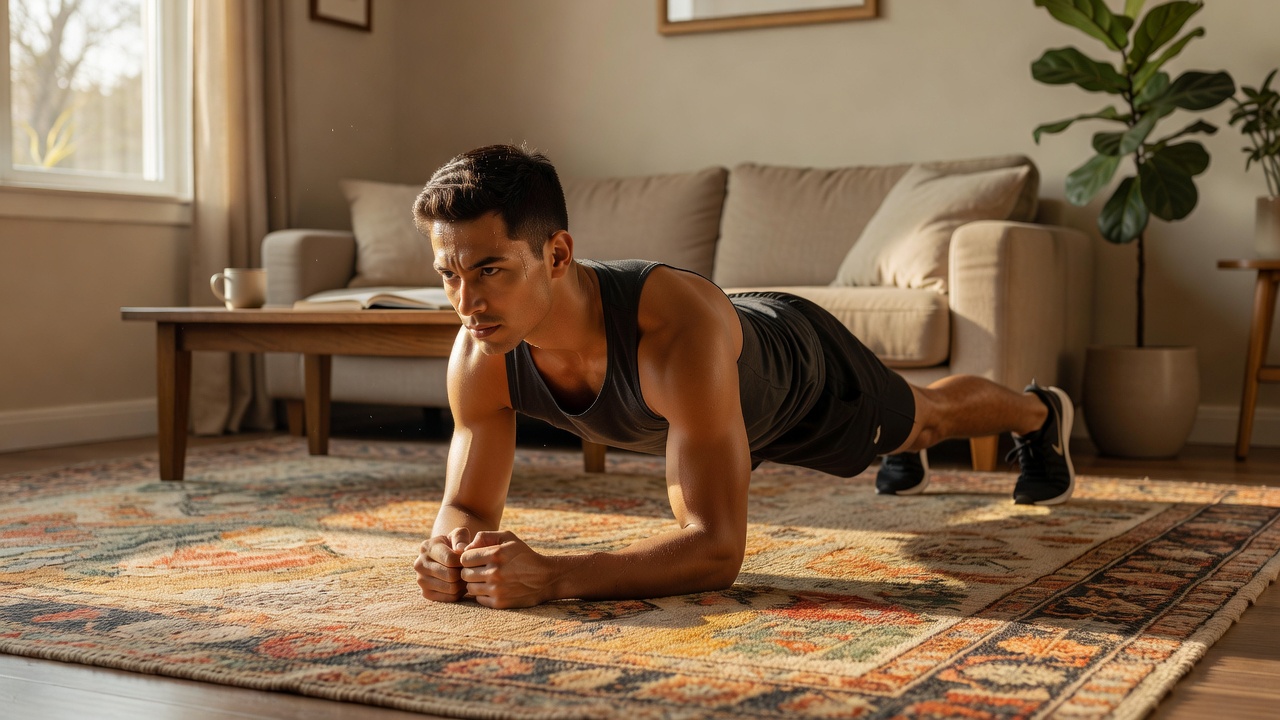
The most common misconception regarding bodyweight training—often referred to as calisthenics—is that it is strictly an endurance modality. Many believe that without external load, the only way to progress is by adding repetitions until you are performing sets of fifty pushups. However, if your goal is strength and hypertrophy (muscle growth) within the confines of a small room, high-repetition endurance is an inefficient path. Instead, you must master the manipulation of biomechanical leverage.
The Mechanics of Leverage Manipulation
When you cannot add weight to the bar, you must change the length of the lever or alter the center of gravity to make a movement more difficult. A standard pushup distributes your body weight across four points of contact. To increase the load on the pressing musculature without adding equipment, you alter those points of contact.
For example, elevating your feet on a sofa or chair shifts more of your body's center of mass over your hands, turning a horizontal push into a decline push, which targets the upper pectoral fibers and anterior deltoids with significantly more resistance. Moving further, the archer pushup involves keeping one arm straight to the side while lowering yourself on the other arm, effectively shifting roughly 70-80% of your upper body weight onto a single limb.
The 2x2 Meter Lower Body Challenge
The most difficult muscle group to train with bodyweight alone is the lower body. Legs are designed to carry you all day, meaning air squats quickly lose their strength-building utility. In a two-by-two meter space, you cannot perform walking lunges or sled pushes. The solution lies in unilateral (single-leg) training.
The Shrimp Squat vs. The Pistol Squat
The pistol squat (a one-legged squat with the non-working leg extended straight out in front) is famous, but it requires significant hamstring flexibility and often leads to lower back rounding (butt wink) for many practitioners. In a cramped space, extending a leg fully forward might even mean kicking a wall.
The shrimp squat is often a superior alternative for apartment dwellers. In this movement, you bend the non-working leg behind you (as if stretching your quad) and lower your back knee to touch the floor behind your working heel. This keeps your mass centered over a smaller footprint and places intense, targeted demand on the quadriceps and glutes of the working leg without requiring the extreme mobility of the pistol squat.
Tempo: The Hidden Variable
If you cannot change the weight or the leverage, you can change time under tension. Tempo training dictates the speed at which you perform the eccentric (lowering), isometric (pause), and concentric (lifting) phases of a movement.
A standard pushup might take one second down and one second up. By changing the tempo to a 4-2-1 count (4 seconds lowering, a 2-second pause hovering just above the floor, and an explosive 1-second push up), you vastly increase the metabolic stress and mechanical tension on the muscle fibers. A set of eight repetitions performed at this tempo will often induce failure faster than twenty fast-paced repetitions, requiring zero extra space.
Programming for Small Spaces
To avoid structural imbalances, a bodyweight routine must include pushing, pulling, squatting, and hinging. While pushing and squatting are easy on the floor, pulling and hinging are notoriously difficult without equipment.
- Horizontal Pulling: If a pull-up bar is impossible, the "door frame row" is a viable alternative. Grasp the vertical trim of a sturdy doorframe, place your feet near the base, lean back until your arms are straight, and pull your chest to the frame.
- Hinging: The Nordic hamstring curl is the gold standard for bodyweight posterior chain development. You can perform these by securing your ankles under a very heavy sofa or bed frame (use a towel for padding) and slowly lowering your torso to the ground using only your hamstrings to brake the descent.
By treating your body as a mutable weight rather than a fixed one, a tiny patch of floor becomes a comprehensive strength-training environment.