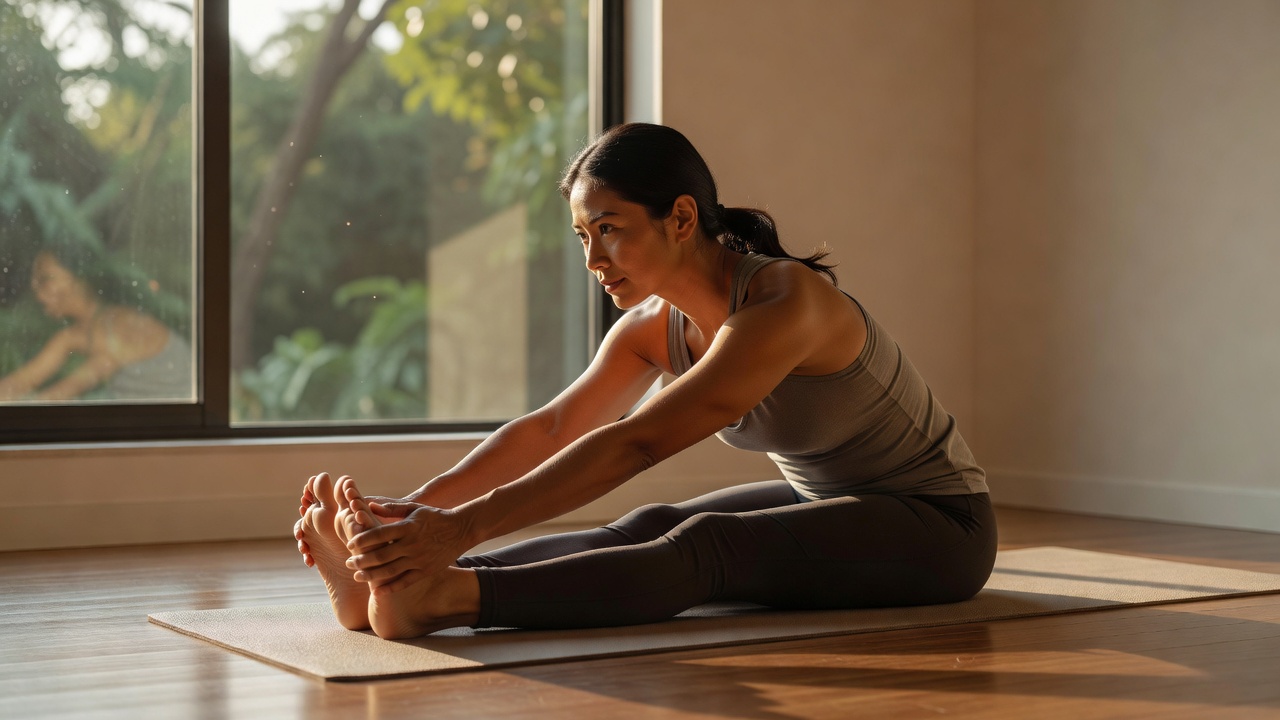
Effective recovery is often depicted as requiring vast open floor spaces, sprawling yoga flows, and unrestricted limb extensions. In a micro-apartment or studio, a simple lying hamstring stretch can result in kicking a coffee table, and a wide-stance straddle stretch is geometrically impossible. Recovery protocols must therefore be adapted to verticality and confined vectors.
The Wall as a Mobility Tool
When horizontal space is lacking, vertical space becomes your primary asset. A blank section of wall (or even a sturdy door) offers immense leverage for static stretching without requiring floor space.
- Legs-Up-The-Wall: A classic restorative pose. Lying on your back with your glutes against the baseboard and legs extended straight up the wall encourages venous return, reduces lower body edema, and provides a gentle, passive stretch to the hamstrings while occupying only the length of your torso on the floor.
- Wall Pectoral Stretch: Place your forearm flat against a doorframe with your elbow bent at 90 degrees. Gently rotate your torso away from the arm. This requires zero floor space and is highly effective at combating the rounded-shoulder posture common in desk workers.
- Wall Sit Soleus Stretch: Dropping into a partial wall sit and elevating one heel allows you to place targeted bodyweight pressure into the lower calf (soleus) and Achilles tendon complex, vastly improving ankle mobility in a footprint no larger than your shoes.
Targeted Myofascial Release
Foam rollers are excellent, but full-body sweeping rolls require significant room to move the body over the cylinder. In tight quarters, pinpoint release tools are far more efficient.
A simple lacrosse ball or specialized mobility sphere takes up zero space and allows for deep tissue work against a wall or in a seated position. Instead of rolling up and down the floor to hit the rhomboids, you can place a lacrosse ball between your back and the wall, using slight knee bends to massage the targeted area. This keeps your body relatively stationary while applying intense, localized pressure.
Dynamic vs. Static Space Needs
Dynamic stretching (movements like leg swings or arm circles) requires a radius of clear space to avoid striking objects. If space is severely restricted, shift your focus entirely to isometric and static stretching.
Isometrics involve contracting a muscle against an immovable resistance (like a doorway frame) without changing the muscle's length. This builds strength at end ranges of motion and signals the nervous system to relax the antagonist muscle, improving flexibility without requiring the sweeping kinetic motions of dynamic warm-ups.